
S24 vs. Notary: The Ultimate Foreigner’s Guide to Polish Company Formation
The S24 Catch-22: e-PUAP and PESEL
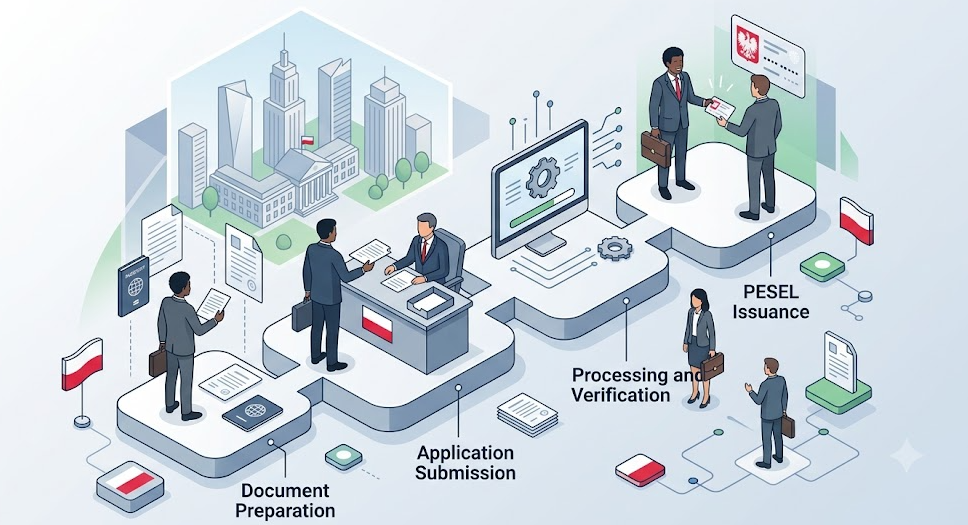
The S24 system is Poland’s online company registration portal, requiring an e-PUAP trusted profile or an eIDAS-compliant digital signature. Foreigners often face a “Catch-22” because obtaining e-PUAP generally requires a Polish PESEL number and a verified identity.
The Mechanics of the S24 Platform
Poland engineered the S24 portal to radically digitize and accelerate corporate launches for small businesses. Founders log directly into the Ministry of Justice system, populate standardized corporate forms, and validate them electronically. State authorities process these streamlined digital applications rapidly, bypassing traditional paper reviews. The interface entirely eliminates the need for physical legal counsel during the core filing stage.
Data from recent corporate setups shows that non-residents hit an immediate wall. Accessing the system requires a verified digital identity. A Polish PESEL number unlocks the free e-PUAP trusted profile. Securing a PESEL from abroad, however, requires specific legal grounds and often a physical visit to a consulate.
Navigating eIDAS Digital Signatures
Foreigners possess a highly effective alternative to the domestic bureaucratic loop. An eIDAS-compliant qualified electronic signature functions identically to a local e-PUAP profile within the S24 ecosystem. European directives mandate that Polish courts accept these certified digital tokens unconditionally.
Commercial providers issue these secure digital signatures for approximately 250 to 600 PLN annually. Setting up the token involves remote video verification, entirely bypassing the PESEL requirement. Founders upload their passport scans during a short video call to activate their signing certificate within hours.
The 2026 e-Doręczenia Mandate
As of 2026, the S24 portal enforces strict compliance regarding national electronic delivery addresses (e-Doręczenia). Founders inputting their company data must legally declare an active, state-certified e-delivery mailbox. Securing this digital mailbox prior to filing prevents unexpected, frustrating application rejections.
The government utilizes this secure channel to replace all traditional registered mail communications with corporate entities. Setting up e-Doręczenia operates as a mandatory prerequisite for anyone seeking to finalize a modern Polish corporate structure.
The Notarial Route: Powers of Attorney
The notarial route allows you to form a Polish company using custom Articles of Association signed before a notary public. Foreigners bypass traveling to Poland by granting a notarized and apostilled Power of Attorney to a local representative.
Drafting Bespoke Corporate Clauses
Standardized S24 templates severely restrict shareholder agreements by offering rigid, non-negotiable clauses. Complex corporate structures inherently demand bespoke legal frameworks to protect investor interests. The traditional notarial path provides total freedom to draft specific voting rights, tailored dividend preferences, and advanced board mechanisms.
Strategic joint ventures require this flexibility to enforce drag-along or tag-along clauses. Founders bringing in venture capital refuse standardized digital forms because they fail to protect minority shareholder rights. Custom articles guarantee precise control over future equity dilution.
Executing Remote Representation
In our practice tracking CEE markets, foreign investors overwhelmingly choose the notary path for complex entities. Incorporators completely sidestep the requirement to travel to Warsaw by leveraging a local legal proxy. A Polish corporate lawyer executes the incorporation documents flawlessly under a precise, specialized mandate.
This remote structure insulates founders from linguistic barriers and local logistical hurdles. The appointed proxy attends the notarial reading, signs the foundational acts, and formally establishes the company on your exact terms.
Legalizing Cross-Border Documents
Preparing the required Power of Attorney involves rigorous, unyielding administrative steps. Local lawyers draft the proxy document in bilingual formats, allowing execution before a notary in your home jurisdiction. Securing an Apostille or completing consular legalization cements the document’s international legal validity.
Polish registry courts strictly mandate a sworn translation of these foreign-certified documents before accepting the final registration filing. Missing a single legal stamp on the Power of Attorney forces the court to reject the application outright.
Capital Requirements (5,000 PLN) & Costs
A Polish limited liability company (Sp. z o.o.) requires a minimum share capital of 5,000 PLN. Forming via S24 costs just 250 PLN in state fees, while the notarial route averages 2,500 PLN including translation and notary fees.
Understanding the Statutory Baseline
Financial entry barriers in Poland remain highly competitive compared to neighboring Western European jurisdictions. The statutory minimum capital of 5,000 PLN equals roughly 1,100 EUR based on standard exchange rates. Shareholders deposit these initial funds directly into the corporate bank account shortly after registration.
The newly formed entity utilizes this capital freely for operational expenses, rather than locking it away indefinitely in a frozen state account. Founders leverage these funds to pay early accounting retainers or secure virtual office leases immediately.
The 2026 Fee Reductions
Registration costs diverge sharply depending on your chosen structural formation path. A major 2026 legislative update permanently abolished the mandatory 100 PLN publication fee for the Court and Commercial Gazette (MSiG). Consequently, the S24 state court fee dropped to a flat, highly attractive 250 PLN.
Startups operating on lean, bootstrapped budgets leverage this specific track to aggressively minimize early cash burn rates. Avoiding notarial involvement keeps the foundational legal spend effectively near zero.
Calculating Traditional Overhead
Notarial setups trigger a predictable cascade of additional procedural expenses. The base National Court Register (KRS) fee jumps to 500 PLN for all paper-based or PRS portal submissions. Notary fees scale directly with the declared share capital but typically hover around 1,000 PLN for standard minimum-capital companies.
Adding sworn translation costs and the mandatory 1% civil law transaction tax (PCC) pushes the total setup baseline well past 2,500 PLN. Complex structures demanding extensive bilingual drafting easily double these legal overhead costs.
Financial Comparison Matrix
| Feature / Cost Component | S24 Portal (Digital) | Notarial Route (Traditional) |
|---|---|---|
| Processing Time | 1 to 3 Business Days | 3 to 6 Weeks |
| Articles of Association | Standardized Template Only | Fully Customizable Clauses |
| State Court Fee (KRS) | 250 PLN | 500 PLN |
| MSiG Publication (2026) | Abolished (0 PLN) | Abolished (0 PLN) |
| Notarial Fees | 0 PLN | Approx. 1,000 – 1,500 PLN |
| PCC Tax (1% of Capital) | 0 PLN | 50 PLN (on 5,000 PLN min. capital) |
| Sworn Translation Costs | 0 PLN | Approx. 400 – 800 PLN |
| Required Signatures | e-PUAP or eIDAS (Digital) | Physical Presence or Proxy |
Timeline Comparison for Non-Residents
S24 registration typically takes 1 to 3 business days once all digital signatures are ready. The notarial route takes 3 to 6 weeks, depending on registry court backlogs and international document shipping times.
The Advantage of Digital Speed
Speed serves as the undeniable primary advantage of the Polish digital corporate ecosystem. The National Court Register legally mandates a theoretical one-day processing time for clean S24 submissions. Assuming flawless data entry and proper digital signatures, your business entity materializes almost overnight.
Tech startups value this rapid deployment to secure immediate vendor contracts, lease agreements, and domestic banking setups. E-commerce operators rapidly integrate local payment gateways the exact same week they submit their S24 filing.
Factoring in Registry Court Delays
We consistently see that the notarial process demands significant administrative patience from foreign founders. Drafting custom articles and arranging secure international couriers consumes the entire first week of the project. Securing sworn translations upon the document’s arrival in Poland easily adds another three to five business days.
Only after compiling the complete physical dossier does the legal team submit the final application via the PRS portal. Missing a single signature forces lawyers to restart the international courier process entirely.
Post-Registration Bottlenecks
Polish registry courts possess a statutory mandate of up to one month to process these non-standard filings. Holiday seasons, regional administrative backlogs, and complex structural reviews frequently stretch this legal timeframe to its absolute limit.
Founders requiring immediate, guaranteed operational readiness should prioritize securing eIDAS signatures and utilizing the accelerated S24 track instead. Once registered, expect an additional two weeks of friction when opening a domestic corporate bank account due to rigorous European KYC checks on foreign directors.
Frequently Asked Questions (FAQ)
Company formation in Poland generates recurring inquiries from global investors. Below are immediate, factual answers regarding remote registration, state fees, and digital identity requirements for 2026.
Can I use S24 without visiting Poland?
Yes. Foreigners register a company via the S24 portal entirely remotely. Securing an eIDAS-compliant qualified electronic signature via online video verification replaces the absolute need for a physical visit or a Polish PESEL number.
Is the 5,000 PLN share capital a locked deposit?
No. The minimum share capital functions as initial operating funds. Once deposited into the newly formed corporate bank account, the company spends this money freely on marketing, salaries, inventory, or necessary office equipment.
Did the 2026 law change the S24 registration costs?
Yes. The Polish government completely abolished the mandatory 100 PLN publication fee for the Court and Commercial Gazette (MSiG). S24 state court fees now stand at a strict, flat rate of just 250 PLN.
What is the difference between a PESEL and an e-PUAP?
A PESEL serves as a unique 11-digit Polish national identification number assigned to residents. An e-PUAP operates as a digital trusted profile used to securely sign government documents. You need a PESEL to activate a free e-PUAP account.