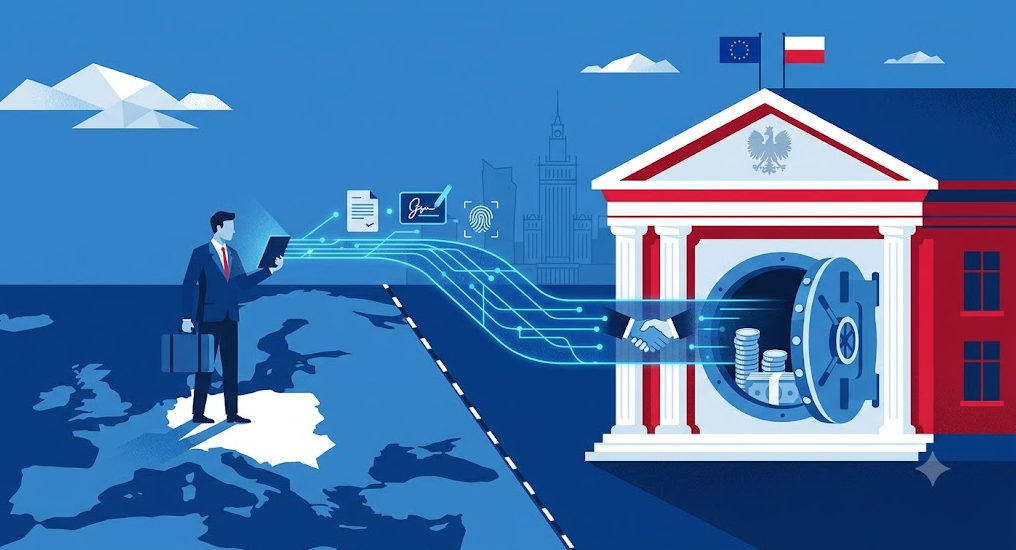
Central and Eastern Europe stands as a primary gateway for international founders seeking access to the European Union market. Poland remains the most strategic jurisdiction in 2026, offering a reduced 9% Corporate Income Tax (CIT) rate for small taxpayers and massive infrastructure growth. Registering a Limited Liability Company (Spółka z ograniczoną odpowiedzialnością) online attracts thousands of foreign expats annually.
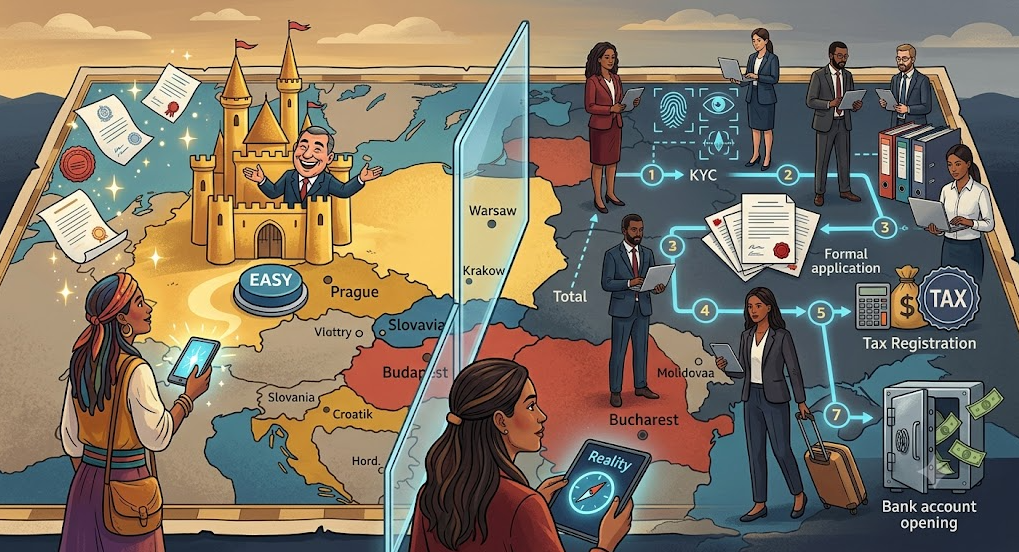
Promoters often sell the idea of a seamless, click-and-done remote registration process. The reality on the ground requires strict compliance with digital identification standards, sworn translations, and rigorous banking protocols. Knowing the actual mechanics of remote incorporation separates successful market entries from costly legal dead ends.
The Real Meaning of ‘Remote’ in Poland (S24)
The S24 system is Poland’s digital registry platform that allows foreign expats to incorporate a standard Limited Liability Company entirely online within 24 to 48 hours using a Qualified Electronic Signature or an ePUAP Trusted Profile.
Many foreign investors assume they can log into the Polish portal and register a business using just a standard email address. The Ministry of Justice strictly enforces identity verification under the European eIDAS regulation. Securing this digital identity constitutes the very first bottleneck for non-residents.
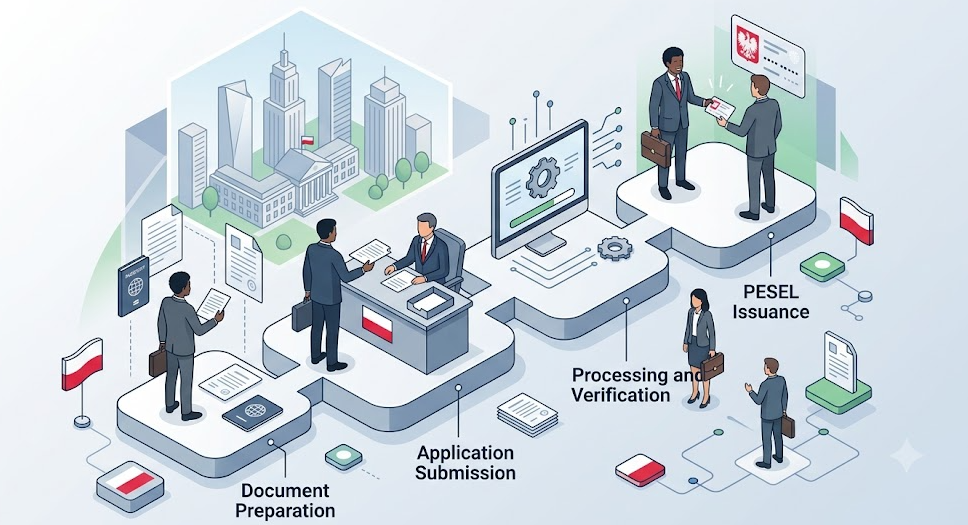
To obtain an ePUAP profile, a foreigner must first apply for a PESEL number, which often requires an in-person visit to a Polish consulate or municipal office. Alternatively, purchasing a cloud-based Qualified Electronic Signature from a certified European provider avoids the PESEL requirement entirely. This cryptographic signature demands careful technical setup but allows true remote execution.
In our practice tracking CEE markets, we consistently see that founders underestimate the rigidity of the S24 template. The digital system only permits basic, standardized clauses for your Articles of Association. Every founder and board member must sign the generated XML files electronically before court submission.
If your corporate structure requires custom legal agreements, the S24 route immediately becomes invalid. You must instead pursue a traditional notarial deed in Poland. Entering the market in 2026 also means immediate compliance with the Krajowy System e-Faktur (KSeF), Poland’s mandatory national e-invoicing framework.
Costs and Capital Requirements
Using the S24 system significantly lowers official court and publication fees. The mandatory National Court Register (KRS) and Monitor Sądowy i Gospodarczy charges total precisely 350 PLN. The minimum share capital for a Sp. z o.o. remains 5,000 PLN, which translates to roughly 1,100 EUR.
Founders must cover this share capital entirely in cash when using the digital platform. In-kind contributions, such as intellectual property or equipment, force the application into the traditional notarial registration path. Once the court approves the online application, the system automatically assigns your NIP (tax number) and REGON (statistical number).
Overcoming Apostille and Sworn Translation Hurdles
Foreign corporate documents submitted to Polish authorities must bear an Apostille or formal legalisation, followed immediately by a certified translation into Polish executed by a state-recognized sworn translator.
Registering a Polish subsidiary owned by a foreign parent company introduces immediate paperwork friction. The Polish court requires an official extract from your home country’s commercial register. This document proves the parent entity exists and identifies the specific individuals authorised to represent it.
Because this extract originates outside Poland, the court will not accept it at face value. You must obtain an Apostille under the 1961 Hague Convention from your local government authority. If your home country falls outside the Hague network, full consular legalisation applies instead.
Managing Translation Realities
Once the physical document arrives in Poland, standard translation services will not suffice. Polish law demands a sworn translator (tłumacz przysięgły) to convert the text and affix their official registered seal. The sworn translation process transforms dense foreign legal documents into valid Polish legal instruments.
Sworn translators charge by a statutory page length of exactly 1125 characters with spaces. Complex foreign commercial extracts easily span twenty pages, leading to high translation costs and unexpected delays. We continually advise clients that gathering and translating these corporate documents adds three to four weeks to the rapid incorporation timeline.
Individual expats registering a company in their own name face significantly fewer hurdles. Establishing the entity as a natural person via S24 bypasses the foreign registry extract entirely. The system verifies the individual identity via the cryptographic signature, eliminating the translation bottleneck.
Using Local Legal Proxies Effectively
A local legal proxy acts under a notarised Power of Attorney to execute company formation steps on your behalf, bridging the gap when digital signatures fail or custom Articles of Association demand a physical notary visit.
When the S24 system cannot accommodate your business model, you face the traditional notarial path. Flying to Warsaw or Krakow simply to sign documents wastes valuable time and financial resources. Engaging a local legal proxy solves this geographical problem efficiently.
You grant a trusted attorney or corporate advisor the authority to represent you before the Polish notary. Data from recent corporate setups shows that relying on a local proxy reduces administrative rejection rates by up to forty percent. The proxy drafts bespoke Articles of Association and coordinates the notarial appointment to ensure perfect alignment with the Commercial Companies Code.
Drafting the Power of Attorney
Creating a valid Power of Attorney (PoA) for Polish corporate use requires extreme precision. The document must explicitly state the rights granted, including the exact name of the future company and the initial share capital amount. Vague or broadly worded PoAs often face immediate rejection by strict Polish notaries.
Founders must sign this PoA before a notary public in their home country. You then secure an Apostille on the notarised document and courier the physical papers to your proxy in Poland. This hybrid remote strategy perfectly balances legal flexibility with your physical absence.
This proxy mechanism extends well beyond initial company formation. A legal representative can submit your VAT-R registration forms, liaise with the tax office regarding your KSeF setup, and handle ongoing compliance tasks. Having a native proxy shields you from misinterpreting critical official correspondence.
Remote Banking Solutions That Actually Work
Opening a corporate bank account entirely remotely in Poland remains restricted by Anti-Money Laundering laws, forcing foreign directors to utilize local proxies, video verification, or interim European fintech solutions to operate.
Securing the National Court Register number often feels like a victory, but the banking hurdle immediately follows. Traditional Polish banks mandate stringent Know Your Customer (KYC) protocols for foreign-owned entities. Most major institutions require at least one board member to appear physically at a branch to verify identity and assess money-laundering risks.
Some progressive Polish banks introduced remote video verification in 2026. However, these systems usually rely on the applicant holding a Polish e-ID (mObywatel) or an active local phone number. Lacking these specific regional credentials causes the automated video verification software to block the application entirely.
Navigating AML and Fintech Alternatives
Opening a corporate account triggers a deep review by the bank’s compliance department. Submitting local supplier contracts, Polish client agreements, or a clear commercial business plan significantly increases your approval odds. Without demonstrating local substance, traditional banks will quickly decline your application.
Founders cannot afford to pause operations while fighting banking bureaucracy. European Electronic Money Institutions (EMIs) provide a vital bridge during this initial setup phase. Platforms operating under Lithuanian or Belgian licenses allow fully remote onboarding for Polish companies within days, providing a dedicated PLN IBAN.
While EMIs solve immediate invoicing needs, they carry distinct limitations regarding the Polish VAT White List. Tax authorities verify standard Polish commercial bank accounts much faster. Eventually, establishing a relationship with a tier-one Polish bank becomes necessary for complex local payroll and seamless tax settlements.
Comparing Registration Pathways
| Feature | S24 Online Portal | Traditional Notarial Deed |
|---|---|---|
| Processing Time | 24 to 48 hours | 3 to 6 weeks |
| Articles of Association | Strict standard template only | Fully customisable clauses |
| Capital Contribution | Cash only (minimum 5,000 PLN) | Cash or in-kind assets permitted |
| Signature Method | Qualified Electronic Signature / ePUAP | Physical signature or Notarised PoA |
| Court Registration Fee | 350 PLN | 600 PLN (plus notary fees) |
Frequently Asked Questions (FAQ)
Find quick, definitive answers to the most common queries regarding company formation, tax obligations, minimum capital requirements, and regulatory compliance for expats entering the Polish market.
Can a non-EU citizen register a company in Poland?
Yes, non-EU citizens possess the exact same rights to form and own a Sp. z o.o. as Polish or EU nationals, without requiring a local resident director.
What is the minimum share capital required for a Sp. z o.o.?
The minimum required share capital is 5,000 PLN (approximately 1,100 EUR), which must be fully paid by the founders before filing the final registration application with the court.
Does the S24 system support in-kind capital contributions?
No, the digital S24 portal strictly accepts only cash contributions for share capital. Any injection of intellectual property, real estate, or physical equipment requires the traditional notarial registration path.
How fast can I start invoicing Polish clients?
You can technically issue invoices the moment your KRS and NIP numbers arrive, but you must register for VAT and configure the mandatory KSeF e-invoicing system first to remain compliant.