
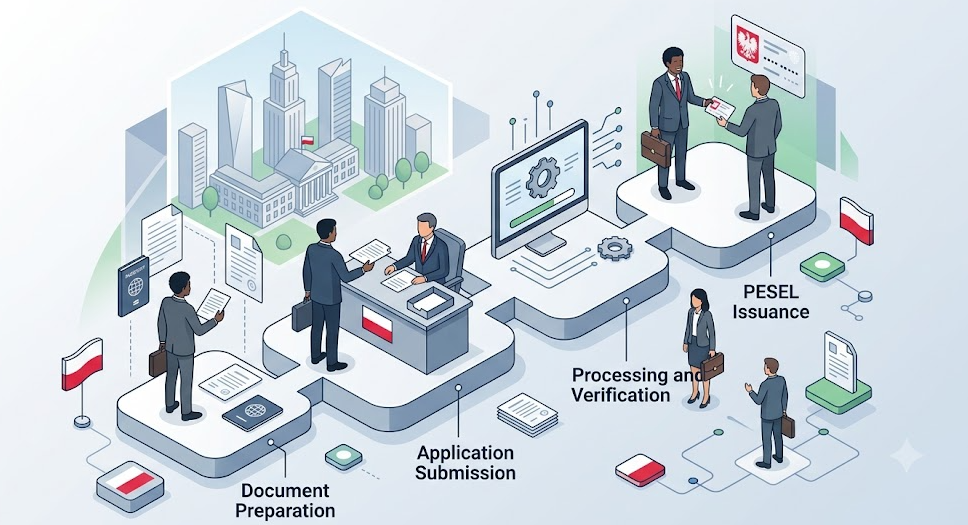
Why You Need a PESEL for the S24 System
A PESEL number is a mandatory 11-digit Polish identification code required to activate an e-PUAP Trusted Profile, enabling foreign directors to digitally sign corporate formation and financial documents inside the S24 portal.
Establishing a Polish Limited Liability Company (sp. z o.o.) via the internet demands specific digital tools. The government’s S24 platform completely replaces traditional, expensive notarial deeds with a streamlined digital interface. Polish law requires all corporate founders and incoming board members to sign the electronic articles of association securely. Without a recognized digital signature, your entire registration process halts immediately.
In our practice tracking CEE markets, we consistently see that foreign founders severely underestimate the time needed to clear this administrative hurdle. They wrongly assume they can simply upload a scanned passport and proceed with the filing. The government portal explicitly rejects unauthenticated foreign users. A Polish identification number bridges the critical gap between your foreign identity and Poland’s public digital infrastructure.
The National Court Register (KRS) strictly enforces electronic filing for all post-registration corporate compliance. Management board members must submit annual financial statements digitally through the designated repository. These crucial documents mandate a qualified electronic signature tied directly to a verified identity. Your administrative number acts as the foundational key to unlock this signing capability.
Foreign executives often confuse the online registration process with a fully automated, borderless system. The S24 platform actually functions as a rigid digital mirror of traditional Polish commercial law. It relies entirely on the local e-ID infrastructure to confirm your consent to corporate obligations. Bypassing this security layer remains technologically and legally impossible.
Navigating Mandatory Digital Infrastructure
Recent shifts in Polish corporate law make digital readiness absolutely non-negotiable for executives. The government rolled out mandatory e-Doręczenia (electronic delivery) for all KRS-registered commercial entities. Registering your company for this official digital inbox requires a system administrator equipped with a Trusted Profile. This compliance mandate brings us right back to the unavoidable PESEL requirement.
New corporate directors often face a harsh reality check during their first financial quarter. The Polish tax administration implemented the National e-Invoicing System (KSeF) as a strict standard for all invoicing. Managing these critical fiscal platforms requires high-level digital authentication to authorize access. Securing your personal identification number early prevents operational paralysis down the line.
The Application Process at the Local Municipality
Applying for a PESEL requires submitting a formal request form and a valid passport at any Polish municipal office, which now mandates an in-person visit for non-EU citizens under 2026 regulations.
Securing your identification number involves physically dealing with the local Polish bureaucracy. The Polish parliament introduced rigid verification laws that officially took effect in January 2026. Non-EU and non-EEA nationals must now appear in person at the municipal office to submit their paperwork. The era of mailing your application through a local proxy or law firm has definitively ended.
Data from recent corporate setups shows that relying on proxies is no longer viable, fundamentally altering budget forecasts for foreign investors. You must account for travel costs, accommodation, and potential translation services when appointing new management. Executives managing global portfolios find this logistical hurdle particularly frustrating and time-consuming. However, non-compliance guarantees a total halt to your corporate registration and banking setup.
You must fill out the official application form entirely in the Polish language. Bring your original passport and a certified sworn translation of any supporting documents if the clerk demands one. Officials will closely scrutinize your entry stamps to verify your legal border crossing into the Schengen zone. Any discrepancy or missing document will lead to an immediate rejection at the counter.
Dealing with Municipal Bureaucracy
Polish municipal clerks strictly adhere to their internal procedural manuals and local regulations. They will not speak English, nor are they legally required to accommodate non-Polish speakers. Hiring a sworn translator or a local legal representative to accompany you is highly recommended. This ensures smooth communication, prevents accidental errors on your submission, and speeds up the transaction.
| Authentication Method | PESEL Requirement | In-Person Visit (2026 Rules) | Estimated Setup Cost |
|---|---|---|---|
| e-PUAP Trusted Profile | Strictly Mandatory | Required for Non-EU/EEA | Free (excluding flight/travel) |
| Certum Qualified e-Signature | Not Required | Remote / Partner Verification | €200 – €300 per director |
| mSzafir Commercial Signature | Mandatory | Via Polish Bank Account | Varies by provider |
Proving Legal Interest as a Board Member
You must justify your application by providing a precise legal basis, typically citing the National Court Register requirement to authenticate online corporate filings as an appointed management board member.
Polish administrative law expressly forbids issuing an identification number simply because a foreigner asks for one. You must specify the exact legal statute that compels you to hold the number in Poland. Foreign directors frequently stumble by writing vague statements about intending to conduct general business activities. Clerks will reject applications lacking a concrete, verifiable statutory reference.
We consistently see that municipal clerks will reject applications that list vague business plans rather than citing the exact article from the KRS act. Your application must explicitly cite the requirement to submit financial statements electronically to the Repository of Financial Documents. Mentioning Article 19e of the National Court Register Act usually satisfies the strict administrative requirements. This proves you possess a binding legal obligation to the state, not just a casual interest.
Lawyers handling corporate formations regularly see applications delayed because directors write generic letters of intent. The Polish administrative procedure code operates on strict, predefined templates and statutory checkboxes. If you fail to map your request directly to a specific legal provision, the system halts. Presenting a flawlessly structured application saves you from fighting endless bureaucratic appeals.
Provide solid supporting documentation alongside your statutory citation to prevent any ambiguity. Attach the official corporate resolution appointing you to the management board of the Polish entity. If the company remains in the formation stage, provide the draft articles of association signed by the founders. These documents validate your claim and leave the municipal clerk with no legal grounds for refusal.
Overcoming Vague Tax Office Requests
Sometimes, a foreign director applies purely because the Polish tax office demands identification. Tax officials occasionally request this number for non-resident executives without providing the actual legal basis. You cannot blindly submit a municipal application stating that the tax office told you to do so. The municipality will deny it immediately due to procedural deficiencies.
Always demand a written legal basis from the tax office before planning your visit to the municipality. If the tax office cannot provide one, you likely need a standard NIP (Tax Identification Number) instead. Distinguishing between a NIP and a personal identification number saves foreign directors weeks of wasted effort. Do not let one government branch send you on a futile administrative loop to another.
Setting up the e-PUAP Trusted Profile
An e-PUAP Trusted Profile is Poland’s free digital identity system that utilizes your PESEL to verify your identity, granting you legal authority to sign corporate documents remotely.
Securing your physical document from the municipality represents only the first half of the battle. You must use that newly acquired 11-digit code to activate your Trusted Profile online. The profile acts as your legally binding virtual pen for all interactions with the Polish state. Without profile activation, the number remains a completely useless string of digits.
Begin the activation phase by registering an account on the official government e-PUAP portal. You will enter your identification details, passport information, and an active phone number. The system generates a preliminary digital identity but keeps the actual signing functions locked. You must verify your identity within exactly 14 days to activate the cryptographic signing capabilities.
Verification happens in two primary ways depending on your financial footprint in Poland. You can easily confirm your identity through a Polish bank account if you already hold one. Most non-resident directors lack this option, forcing them to verify their credentials in person. You must visit a designated confirmation point, like a tax office or Polish consulate, to show your physical passport.
Maintaining Compliance and Signature Validity
Once successfully activated, your Trusted Profile remains legally valid for a period of three years. You use it to log into the S24 system, sign formation documents, and authorize changes to the KRS. The platform recognizes your profile and applies a secure, legally binding timestamp to your digital signature. This satisfies the registry court’s stringent requirements for electronic document authentication.
Monitor your profile’s expiration date diligently to avoid sudden operational roadblocks. Renewing an expired profile requires repeating the entire identity verification process from scratch. A sudden expiration right before the annual financial reporting deadline causes massive corporate compliance headaches. Set internal administrative reminders to renew the profile entirely online before the expiration date hits.
Frequently Asked Questions (FAQ)
This section provides definitive answers to the most common legal, logistical, and timing questions regarding the 2026 application process for foreign executives operating in Poland.
Does obtaining a PESEL make me a Polish tax resident?
No. An administrative identification number does not determine your tax residency status under Polish law. The tax office determines residency by evaluating your center of vital interests and tracking the number of days you spend physically present in Poland.
Can a lawyer apply for my PESEL using a power of attorney?
As of January 1, 2026, most non-EU and non-EEA nationals can no longer use a proxy. You must appear in person at the municipal office to submit your application form and present your original passport to the clerk.
How much does the application process cost?
The administrative procedure to issue the document is entirely free of charge at the municipal level. You only pay for incidental out-of-pocket expenses like certified sworn translations, flights, accommodation, or hiring a local legal guide to assist you.
How long does the entire setup process take?
Municipal offices usually process the application and issue the physical document on the same day. However, verifying your Trusted Profile adds an extra step that requires visiting a separate confirmation point, which could add a few days to your timeline.